

The US has hit Kharg Island, Israel has hit an Iranian railway bridge, Iran has hit a major Saudi industrial city, and three gunmen have been shot in Istanbul by Turkish police after trying to breach the Israeli consulate. The war in Iran is not, exactly, winding down.
“A whole civilization will die tonight,” Trump has posted ahead of his rolling, self-imposed deadline for Iran to make a deal at 8pm this evening (1am in the UK). Will a deal be made? “We will find out tonight, one of the most important moments in the long and complex history of the world,” Trump wrote, as if setting up the finale of a reality show he’s in. “God Bless the Great People of Iran!”
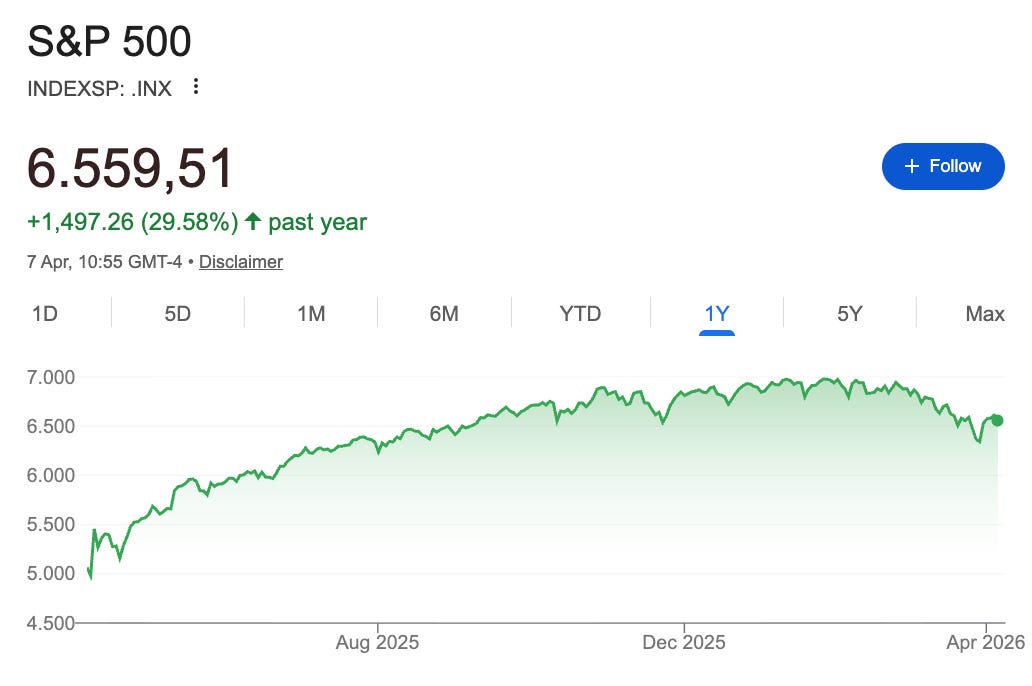
The US stock market is unperturbed. Usually this would make sense. Geopolitical risk rarely heralds stock market crashes. But this isn’t a normal conflict. This, we have been told, is the mother of all crises. So where is the crisis showing up?
It’s not yet visible in food prices. And not all fertiliser prices are shooting up either, despite the shock to urea supply (a fertiliser that I too only recently discovered the existence of). There’s not yet cause to believe the latest cataclysmic post that some exceedingly earnest tech product manager has probably put on X.
Where can we see a cascading effect? In the crude oil supply chain. The price of crude itself – the almost-molten liquid out of which a litany of essential fuel products are created – has ticked up this week after the futures market reopened Sunday night. But the place you can really see the supply shock is in the price of diesel: one of the “middle distillates” made by refining crude. Here’s the price of diesel delivered to New York since 1985. We’re at all-time highs:
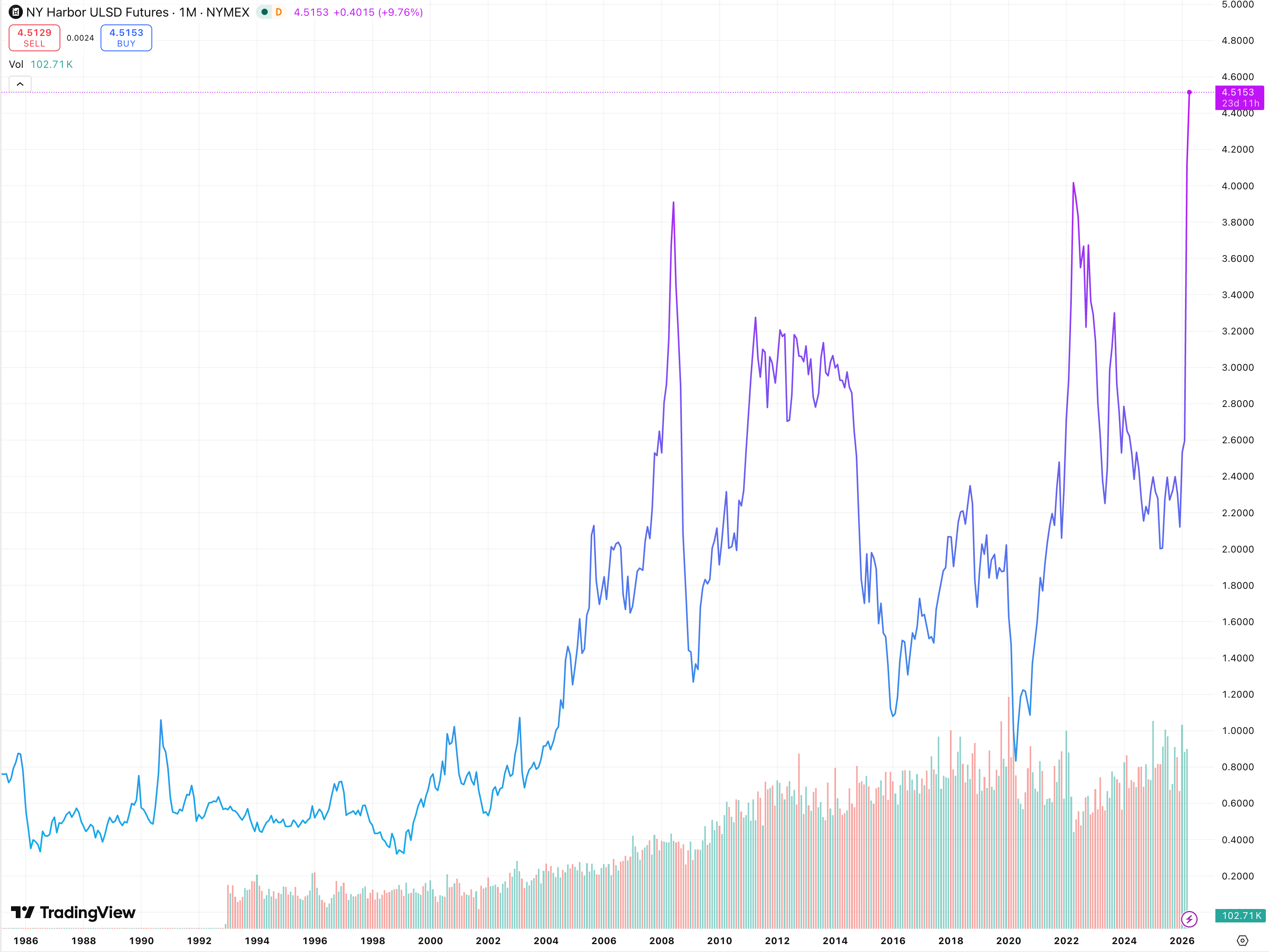
NY diesel is up 73 per cent in 5 ½ weeks. There has never been a spike like it. We’ve had spikes of similar magnitudes before – prices rose almost 60 per cent over 3 ½ months in spring ‘22 after Russia invaded Ukraine, and almost 70 per cent throughout the first half of 2008 – but nothing this sharp, this fast.
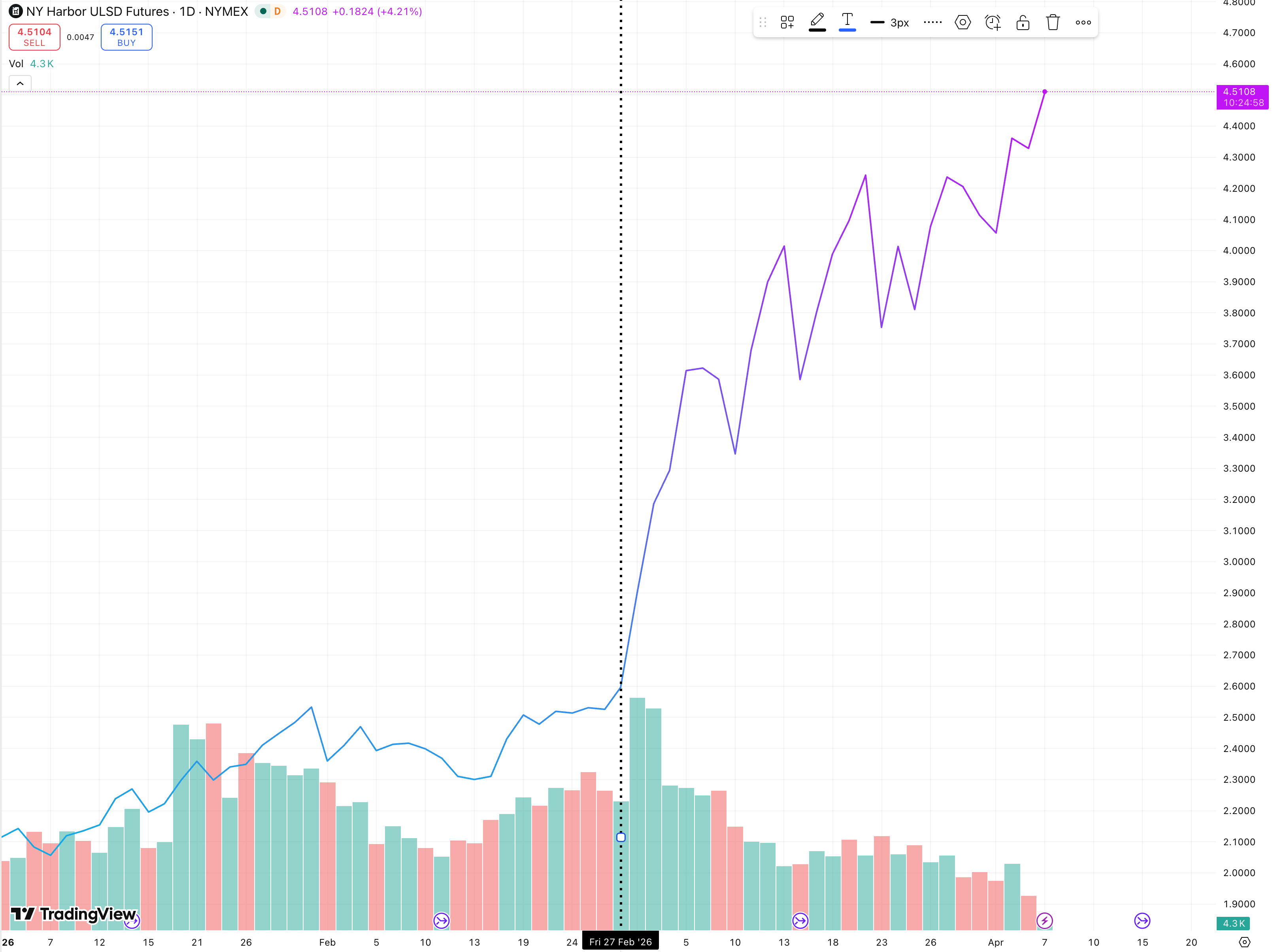
Trump managed to talk down the price of crude two weeks ago. You can see brief evidence of that in the price of diesel below, when I narrow the chart to 2026, but reality soon reasserted itself. If supply remains constrained, the price should rise.
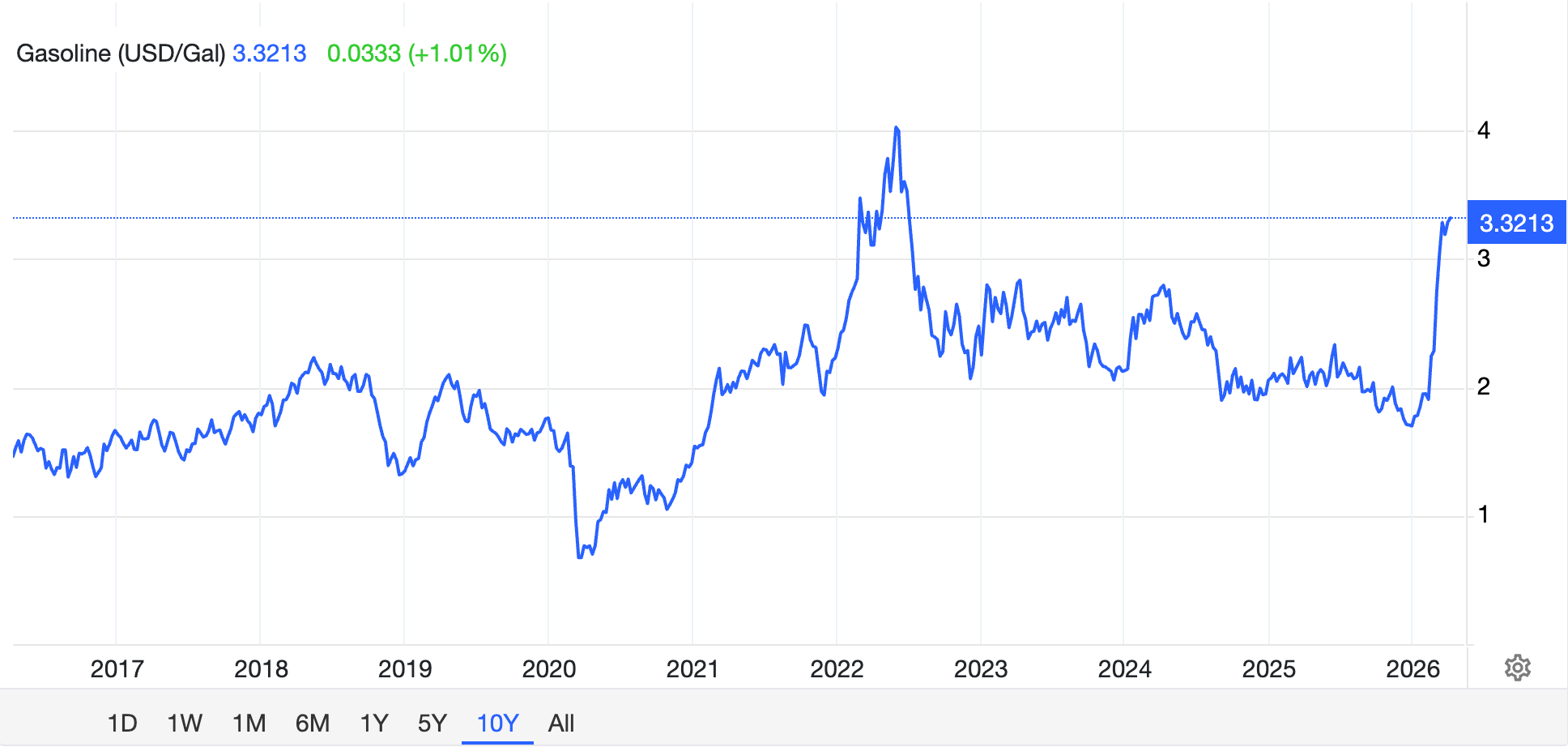
Gasoline, the fuel price American drivers pay, is also made out of crude. In 2022 Trump blamed Biden for causing gasoline prices to spike when Putin was to blame. Now an American president is actually responsible for an even faster spike:
The US military build-up continues. Artillery brigades are en route:
 Tom Cotton@SenTomCottonToday, the brave men and women of Arkansas’ 142nd Field Artillery Brigade depart for the Middle East. Arkansas is thankful for their service. May God protect them.11:45 PM · Apr 6, 2026 · 1.05M Views1.35K Replies · 495 Reposts · 4.57K Likes

More here from energy industry legend Jeff Currie – the man with the lilt, the hair, and the assured prophecies of doom. In short: he expects oil to spike to a demand-destroying peak in mid-to-late April. By Currie’s estimation there was a buffer of around 800 million barrels of oil at the start of the War. Half of that was used up in March, even with the release of strategic reserves (a release that isn’t really happening yet in the US). The rest is being used up now, this month.
Remember: even on days with no news of fresh strikes, the amount of oil missing from the world has gone up.
Currie sees this as Covid inverted: the size of the shock is similar, and it too is spreading around the world. (“I remember thinking then [in late January 2020], the second-largest economy in the world [China] has shut down. This has to be bad. It took six weeks [to hit] then.”) His term for our crisis now: “molecular contagion”.
He thinks this is going to be great for China, as Covid was. More on that soon.
Bob McNally, a Bush-era White House official, is another man of deep experience raising his voice. He expects further escalation.
Helen Thompson, the energy-focused Cambridge professor, spoke to Bloomberg. Britain is on the peripheries of this crisis – our political debate in parliament is, as usual, little more than fine material for good comedy – but Helen explains how decisions made since the ‘70s, and especially the ‘90s, have left Britain exposed to every energy shock. If only we had any unexploited reserves of oil and gas left to drill in the North Sea. Nuclear’s good too.
Talking of comedy, here a few notes, written at the time, from Trump’s press conference yesterday – following the rescue of two American servicemen – to give you a sense of how much more absurd these events are than news reports reveal:
He’s arrived with SecDef Hegseth; Dan “Raizin” Caine, the alert, lyrical, diminutive Chairman of the Joint Chiefs; and John Ratcliffe, the tall CIA Director.
It’s been one of our best Easters, Trump says.
Nobody has the machines that we have. (We’re America.)
The weapons officer they saved this weekend had “a very sophisticated beeper-like apparatus.” Trump’s talking. “When they [the men] go out, they make sure they have lots of battery space and they’re in good shape – and this one worked really well.”
The C-130 transport planes America had to blow up on their way out were, Trump says, “old, very old”. They cost $100m~ each.
It was tough terrain out of which to fly. “You would call it central casting if you were doing a movie, for a location.” (!)
“God was watching us – it was Easter territory, I guess.”
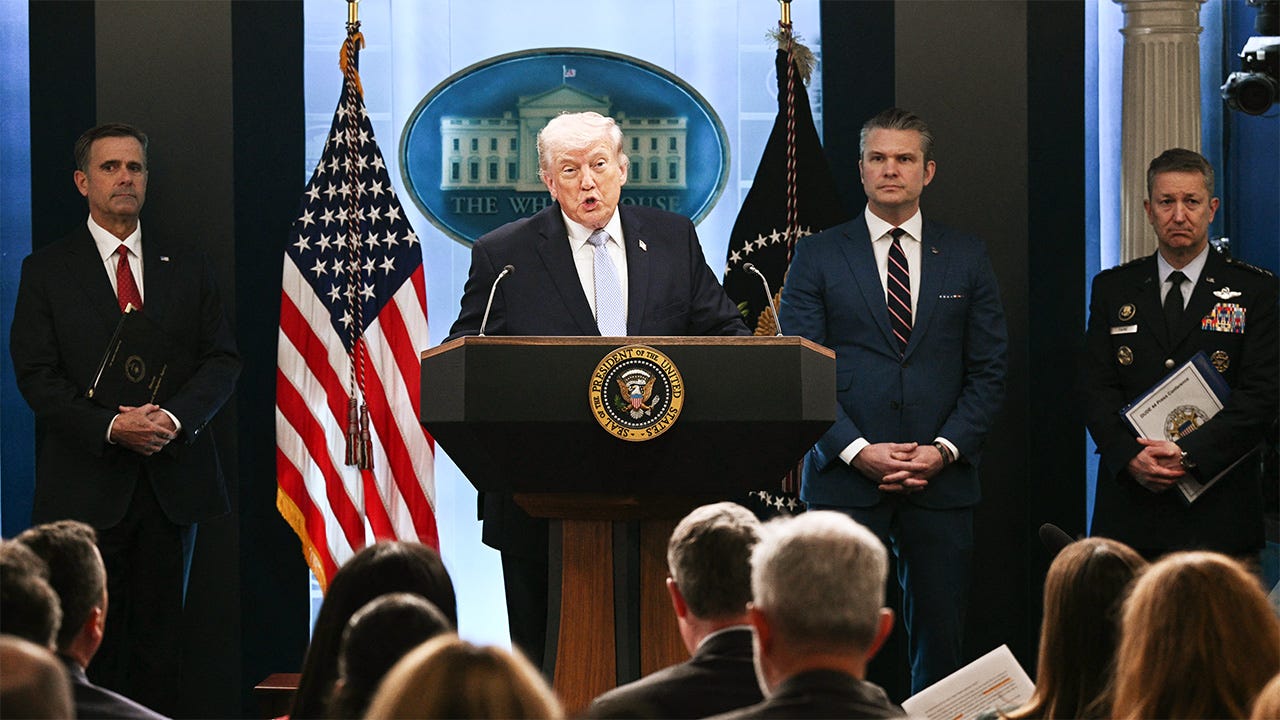
Ratcliffe, Hegseth, Caine. Hegseth’s suit was bluer than this Trump’s been talking about the rescue in almost mystified terms for some time now. It was a-mazing, in short. (It was.)
John Ratcliffe is keeping his head bowed while Trump describes him as a man so out of central casting that he would play the head of the CIA in a movie.
Ratcliffe, whose surprisingly folksy voice would be fit for a Southern talk radio show, has spent most of his time praising the Supreme Leader who introduced him.
Here comes Hegseth. No need to dwell on his penchant for cutaway collars, strobe-striped ties, brown shoes, and too-blue suits that don’t fit.
After quite a bit of bluster, Hegseth is now also turning to his kingly benefactor.
Raizin Caine is a giant among these taller men. When he starts speaking, you wake up. He paints scenes. He could have filed with the best of them.
“On Thursday 2 April at 10:10pm Eastern Time – 4:40 in the morning, local Iran time – the Joint Personnel Recovery Center, which handles the Central Command Area of Responsibility, declared an Isolated Personnel Recovery Event for US Air Force F-15E Strike Eagle – call sign DUDE44 – which was down in hostile Iranian territory. The pilot and weapons system officer had both safely ejected and were isolated behind enemy lines. Following confirmation of active rescue beacons, and on the direction of the Secretary [of War] and by order of the President, a rescue operation was launched with the stated purpose of bringing both Americans home…”
More on Raizin here.
Trump sounds like he’s revealing operational secrets.
As a president you have to have good instinct. A lot of this is instinct. (He says.)
I’m a business man first, says Trump, of taking Iran’s oil. “To the victor go the spoils,” he says. “What happened to that?” I’m paraphrasing him into coherence.
Trump’s now talking about running for President in Venezuela after leaving office, and learning Spanish in preparation for that. Not sure he’ll need it.
 Acyn@AcynTrump: I'm polling higher than anybody has ever polled in Venezuela. So after I'm finished with this, I can go to Venezuela. I will quickly learn Spanish. It won't take too long. I'm good at language, and I will go to Venezuela. I'm going to run for president.6:28 PM · Apr 6, 2026 · 2.1M Views2.47K Replies · 3K Reposts · 12.1K Likes
Trump has modelled his scowl on Churchill’s, right?
Nato’s a paper tiger, Trump says. “Putin’s not afraid of Nato – he’s afraid of us. He’s explained that to me many times.” Upholding the alliance as ever – on ice until 2031.
You know who else didn’t help us? Trump says. South Korea, Australia, Japan. He’s wondering why America has 45,000 troops in South Korea (they have 28,000) when Kim Jong-Un is “very nice to me”.
Back to Nato. “It all started with Greenland. They didn’t want to give it to us, and I said, bye bye.” He walks out.

NB
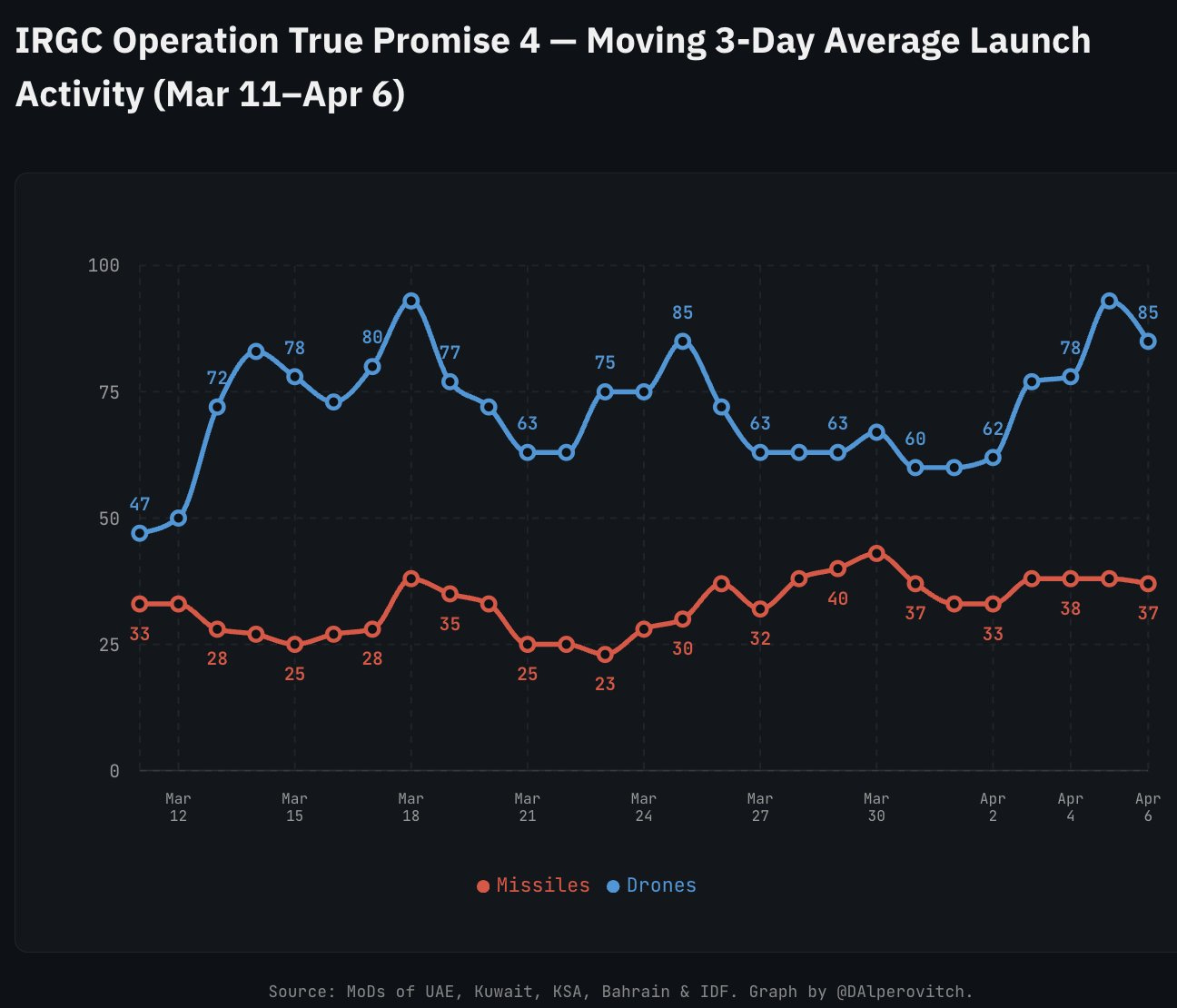
No change in Iranian missile capability. Drone fire is going up. This is after 20,000 US-Israeli strikes.
A young journalist at the BBC is being accused of making up quotes – quite consequential ones. It’s not yet clear what happened, but the piece in question has now been edited without a stated correction. How did this get through?


It’s a reminder that so much journalism is taken on trust by editors. You are rarely asked where a quote is from, and I can’t remember ever being asked to prove a quote’s provenance. A newsroom is, rightly, a high-trust society. You are largely self-regulated. It comes down to your own integrity. “It’s an honourable profession. Dress up for it.”
I’m going to write something longer on Lebanon following conversations I had in Israel. Until then, how is anyone meant to return here? (More evacuation orders.)


The Journal reported on the 20,000 seafarers stranded on tankers in the Strait.
Programming notes
I intend to send out this email each day around lunchtime (liberally defined) when the markets are open. I’m writing this to make sense of the mother of all crises as it unfolds, if that is what this proves to be.
Information is more scattered now than ever before – you have to find it in the saner corners of X, inside podcasts, in old books. Like gathering leaves. If you’re finding this useful and think someone you know might, please send it their way.
The Articles of the Constitution, I heard The Atlantic editor Jeff Goldberg say a couple of months ago, are a set of “vaccinations against tyrannical monarchy. We’re now literally experimenting with how good these vaccines are. That’s what this whole period is. They made these vaccines 250 years ago, and this is a test of whether they actually fight the infection of populism.” More on that here. I sat down with Ken Burns, who has spent 10 years studying the American Revolution.
When you do sit across from him, he is eager to answer your question, and eager also to extend and encapsulate his points when he does. He has an irrepressibility – almost a sense of duty in trying to give you something worth writing down. Perhaps he just knows a lot and wants you to know it too. His vim, undimmed at the age of 73, is inherent in his face. I doubt it would have been repressed wherever he had ended up. But he ended up in the right place for it to find free rein: a village in New Hampshire (Walpole; population: 3,633), where he has lived in the same house for 47 years.
“I take a walk every morning, three miles or so, and I can’t begin to tell you how many filmic problems I’ve solved, how many other kinds of things I’ve solved – letters I’ve written in my head and not sent, ideas I’ve had for speeches or poems, or solutions to the film – because of the space to do that,” he told me. “Nature is a really accurate mirror, and you can’t fool anybody when you’re there.”